

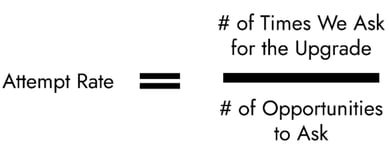
Girl Scout Cookie season is soon upon us here in the United States. As I watch the Girl Scouts go door to door or work the front door of the local grocery store, I can’t help but think of the parallels between what they are doing and hotel upgrades. In fact, the same way that I usually end up with a box of Thin Mints is the same way many guests end up in premium rooms: someone asked them. In this article, I am going to analyze an important metric for our LuxSell hotel upgrade clients: the attempt rate.
What attempt rate tells you
Attempt rate helps a manager see how consistently the team is working through upgrade opportunities. In LuxSell reporting, it is recorded attempts divided by check-ins in the report, expressed as a percentage. Conversion is upsells divided by attempts. They answer different questions and should be reviewed together.
There is an important distinction between a recorded attempt and a conversation. LuxSell records an attempt when an agent opens offers for a guest; an activity record can include an accepted, declined or withheld offer, or offers opened without a decision. The number alone does not prove what was said to the guest. Review outcomes and relevant restrictions before drawing conclusions about an agent’s performance.
For an illustrative example, a report with 100 check-ins, 60 attempts and 12 upsells has a 60% attempt rate and 20% conversion per attempt. Those counts are not revenue or profit, and they are not a customer result. Keep the reporting period, date basis, product filters and population consistent when comparing results.
Just like I don’t go to the grocery store seeking to meet the Girl Scout at the front door and buy a box of cookies, a guest may not arrive thinking about a more premium room. We can present a relevant option, and the decision is theirs. Here are three practices that help turn that principle into a consistent daily process.
Practice One: Monitor & Measure
There is a common phrase in business: “What gets measured, gets done.” Measurement gives managers a starting point for follow-up, but the number needs context. In LuxSell, operators can review attempts alongside conversion and revenue, then ask where agents need support.
Set a target that reflects the property’s market mix, inventory, eligibility rules and current baseline. A leisure resort with ample premium inventory may have a different opportunity from a property with fewer suitable upgrades. A 90% target is not a universal benchmark. The aim is to avoid missed opportunities without pressuring guests or encouraging agents to record activity merely to improve a score.
Before comparing agents, check whether the same reporting definitions apply and whether differences in inventory, guest mix or working patterns affected their opportunities. Review a sample of interactions, not just a ranking.
Practice Two: Coaching and Support
In our experience, the vast majority of agents want to do the right thing and want to do well but may need some additional support to get there. They need to role-play how to ask guests so they develop ease in describing the premium room types. Luxe Pricing supports configuration and training as part of implementation, backed by our customer success team. The training format and support arrangements should be confirmed for each property.
Launch support matters, but so does continuous coaching. Agents need to understand which offers are appropriate, how to explain the benefit and price, and how to accept a decline comfortably. Our articles on reading guest cues and why “no” is normal provide practical ways to reinforce those conversations.
Practice Three: Reward & Accountability
Accountability connects the team’s commitment with its daily behavior. Once agents have clear guidelines, training and support, recognize consistent, well-made offers and follow up when opportunities are repeatedly missed. Where the property uses commissions or other rewards, make the rules clear.
A declined offer can still be a good interaction. Review whether the agent followed the process, presented a relevant choice and recorded the outcome accurately. Address obstacles before treating a low rate as a lack of effort.
A short attempt-rate review
- Confirm the report’s period, population and filters.
- Look at attempts, conversion and revenue together.
- Review a few recorded and missed opportunities, including availability and restrictions.
- Ask what helped or prevented a relevant offer.
- Agree one coaching action and revisit it at the next review.
Conclusion
I’ll close with a challenge to every hotelier who wants their upgrade program to succeed: measure consistently, coach the conversations behind the numbers, and recognize the behaviors that give guests a genuine choice. Attempt rate is useful when it helps the team improve the process, not simply chase a percentage.
Explore LuxSell URS to see how upgrade workflows and performance reporting can support your property’s program.